
by Greg Gillespie, VP, PrimeFab
Off-site construction continues to gain traction across Canada as developers and builders look for faster, more predictable ways to deliver projects. Two approaches often lead the conversation: volumetric modular construction and panelized systems.
Both approaches are promoted for speed, efficiency, and improved quality control. However, in practice, the outcomes can look very different.
Let’s take a closer look at where each method works and where challenges begin to surface.
Understanding the Difference
Volumetric construction involves building complete three-dimensional units in a factory. These units are transported to the site and assembled into a finished structure.
In contrast, panelized construction focuses on manufacturing components such as wall panels, floor systems, and roof assemblies. These are then delivered to the site and installed quickly to create a weather-tight building envelope.
Both methods shift work into an off-site manufacturing environment. The difference lies in how much is completed before arriving on site, and what that means for logistics, cost, and execution.
Where Volumetric Construction Gets Challenging
Volumetric construction is often positioned as the fastest path to completion. However, that speed can come with trade-offs that are not always visible upfront.
-
Site Constraints and Logistics
Volumetric projects require significantly more space on site. Larger modules need room for staging, maneuvering, and installation, which can be difficult in urban or constrained environments.
They also require larger equipment, including mobile cranes, to lift and place each unit, adding complexity, cost, and coordination to the build.
-
Installation Efficiency
While modules arrive more complete, connecting units can be time-consuming. Aligning structural, mechanical, and envelope systems across multiple volumetric units introduces coordination challenges that can impact installation speed.
-
Manufacturing Complexity
From a production standpoint, volumetric facilities are significantly more complex to establish.
- Larger facilities are required to accommodate full units
- Multiple trades must operate within the same controlled environment
- Regulatory requirements can be more intensive
This process creates higher upfront investment and operational overhead, which can limit scalability.
-
Transportation Inefficiencies
Volumetric units often involve transporting large volumes of air, which can reduce shipping efficiency and increase costs, especially over longer distances.
Why Panelized Construction Is Gaining Momentum
Panelized construction takes a more focused approach by prioritizing speed where it matters most: getting the building enclosed and protected as early as possible.
-
Faster Path to Weather-Tight
In Canada’s climate, getting a building weather-tight quickly is critical. Panelized systems allow crews to rapidly install exterior walls, floors, and roofs, reducing exposure to weather and enabling interior work to begin sooner.
-
Simpler Site Requirements
Panelized systems require less space and smaller equipment on-site, making them more adaptable to a wider range of project conditions, including tighter urban sites.
-
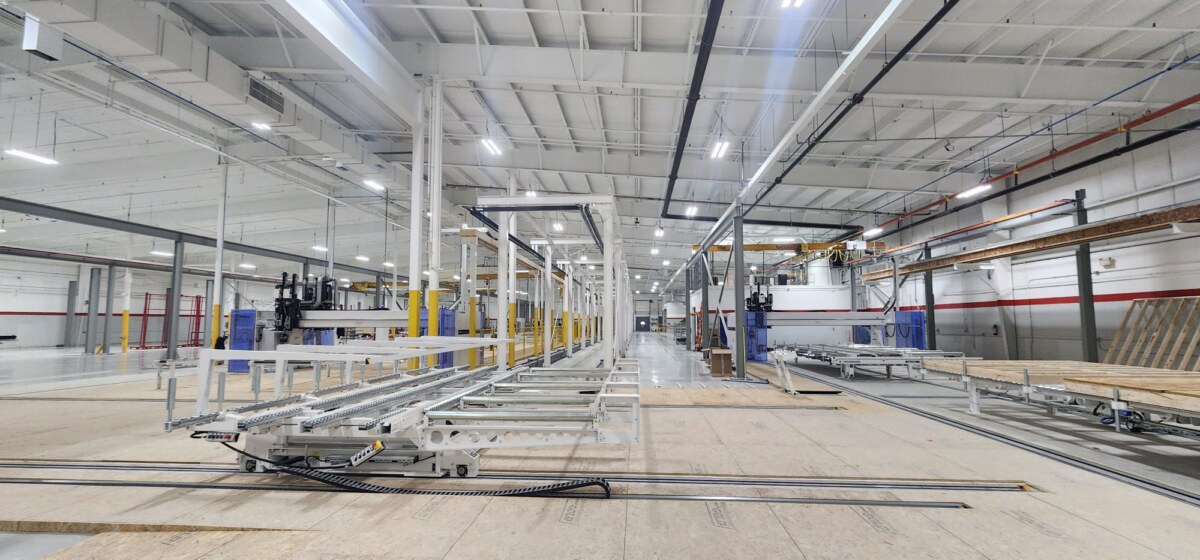
Efficient Manufacturing Setup
Panelized manufacturing can be scaled more efficiently:
- Smaller facilities can support production
- Operations can be established faster
- Trades remain engaged on site rather than fully consolidated in a factory
This manufacturing method provides a more flexible, cost-effective production model.
-
Optimized Transportation
Panels are designed to maximize truckloads, reducing wasted space during transport, leading to more efficient logistics and lower shipping costs.
-
Supporting the Local Workforce
Unlike fully volumetric builds, panelized construction maintains a strong role for local trades. This supports regional labour markets while still delivering the benefits of prefabrication.
Rethinking Speed in Construction
There is a growing push across the industry to build faster. Volumetric construction is often seen as the answer, but speed does not always require a fully turnkey approach.
In many cases, the biggest gains come from improving the early phases of construction. Delivering a high-performance, weather-tight envelope quickly can unlock downstream efficiencies without introducing unnecessary complexity.
A More Practical Path Forward
Both volumetric and panelized construction have their place. The right choice depends on the project, site conditions, and long-term goals.
However, as more projects prioritize scalability, cost control, and adaptability, panelized systems are emerging as a practical solution that balances speed with flexibility.
Final Thoughts
Off-site construction is not a one-size-fits-all solution. The industry is still evolving, and the most effective approaches are those grounded in real-world performance, not just theoretical advantages.
For many Canadian projects, the focus is shifting toward solutions that deliver faster enclosure, simpler logistics, and scalable manufacturing. Panelized construction is well-positioned to meet that need.
If you’re exploring panelized construction for your next project, our team can help you evaluate the right approach and next steps. Request a quote to start the conversation.